Optimisation and control
MasterGA
A genetic algorithm that tunes its own settings, grown out of a flight-control capstone.
The capstone's GA settings were tuned once by an outer search, then hard-coded. MasterGA turns that step into a tool: it tunes the settings for each problem, writes them down as a preset, and reports what each preset costs across seeds rather than on one lucky run.
- Tighter spread across seeds
- 26 ×
- Cheapest preset on target every time
- 1035 evaluations
- Escaped the decoys to the true well
- 28/50 seeds
- Passing
- 399/400 tests
Meta-tuned preset against the best hand-written one: IQR 3.4e-5 against 8.9e-4, 5 seeds, equal 5 000-evaluation budget
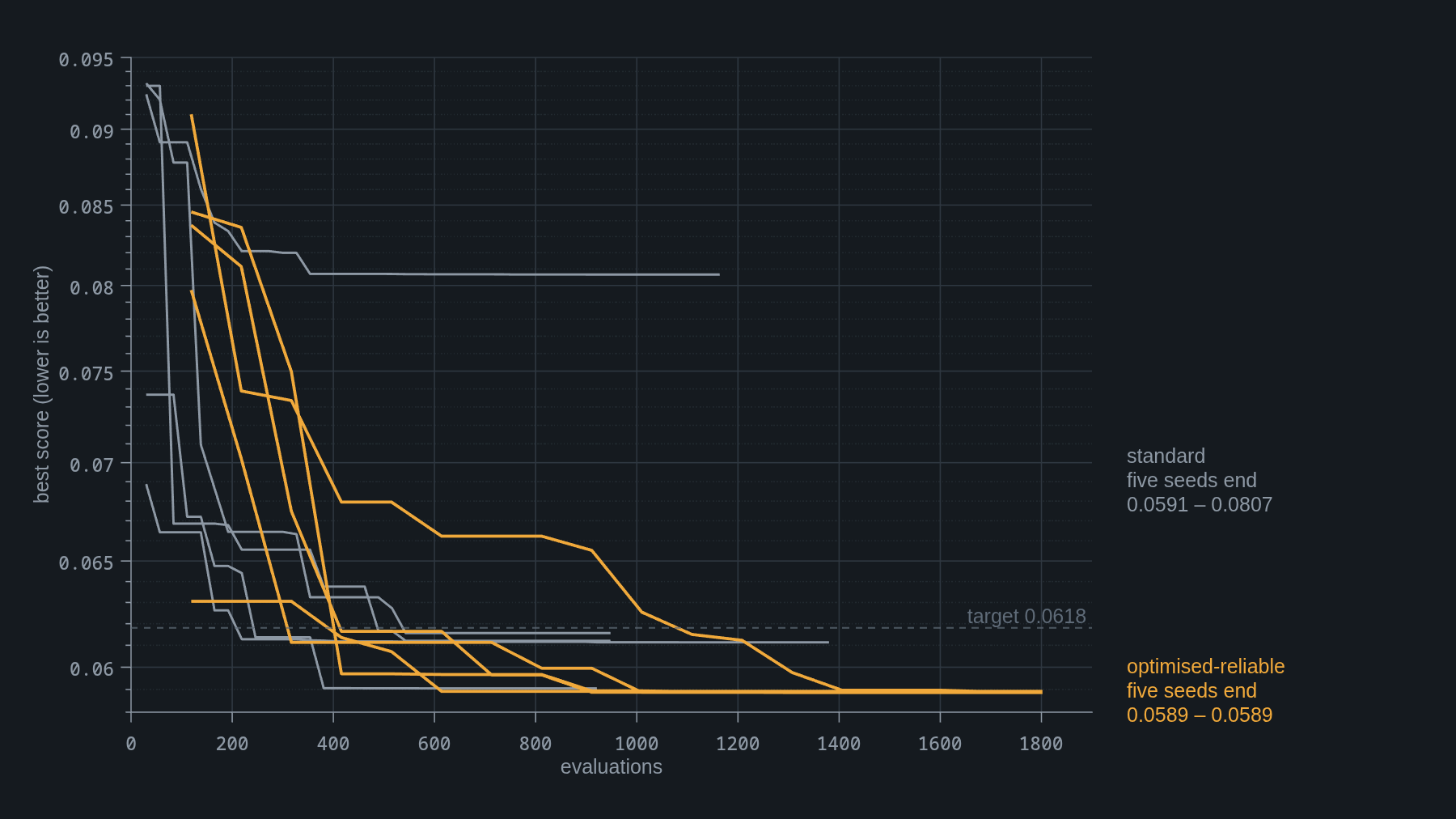
The balanced tuned preset, on target on 5 of 5 seeds of the short-period pitch problem
The escape preset on a 2-D decoy map, against 10 / 50 for standard
Fast suite, 2026-10-06. The one skip is the no-Simulink error path
Measured against limits
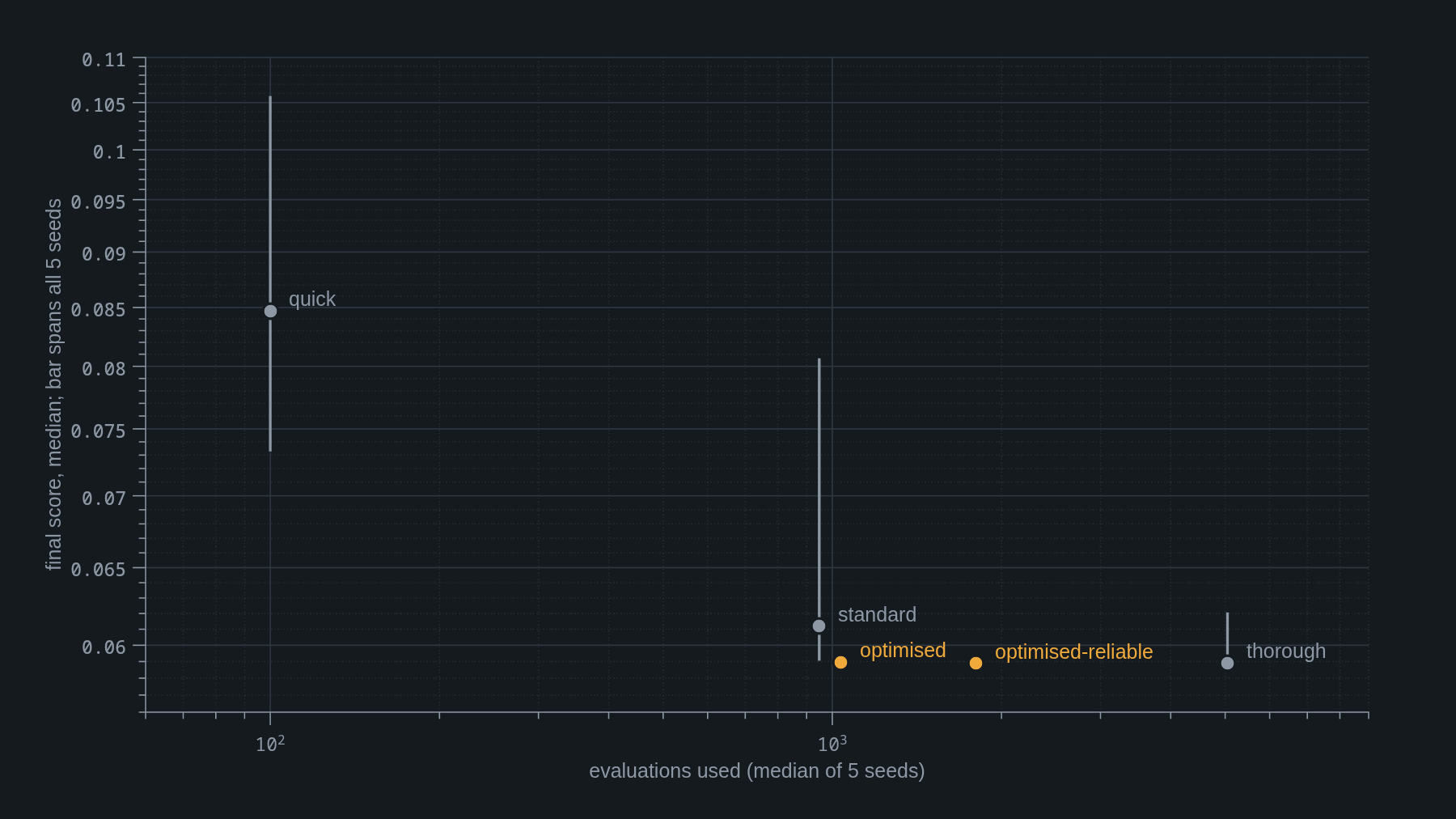
Every preset had the same 5 000-evaluation cap; this one stopped at its own generation limit on every seed, 36 % of what thorough spent.
The accepted criterion is 1e-2. No preset reaches the tighter 1e-3 at the median; the gap is a badly scaled valley, not the tuning.
In sixty seconds
The whole system in one silent minute: the problem, a search getting out of a trap, the preset ladder, the meta-GA and the test suite. Every curve, point and number in it is drawn from the same seeded runs this page cites.
The question
The capstone tuned PID gains and trim schedules for a Cessna's longitudinal dynamics with a genetic algorithm. The GA's own settings — population, generations, selection pressure, mutation — came from an outer tuning harness that searched over them once. The result, a population of 172 run for 28 generations, was then hard-coded into the final scripts.
That leaves the real question unanswered: which settings suit which problem, and what does each one cost? MasterGA answers it with measurements. Every preset is a point on a quality-against-cost curve, and every claim about a preset is a median over seeds with its spread beside it.
One engine, plug-in problems
A problem is a plant — anything that turns a candidate into a response — plus a fitness profile that scores the response. The engine never knows whether it is tuning a pitch controller, trimming an aircraft or hunting a synthetic trap.
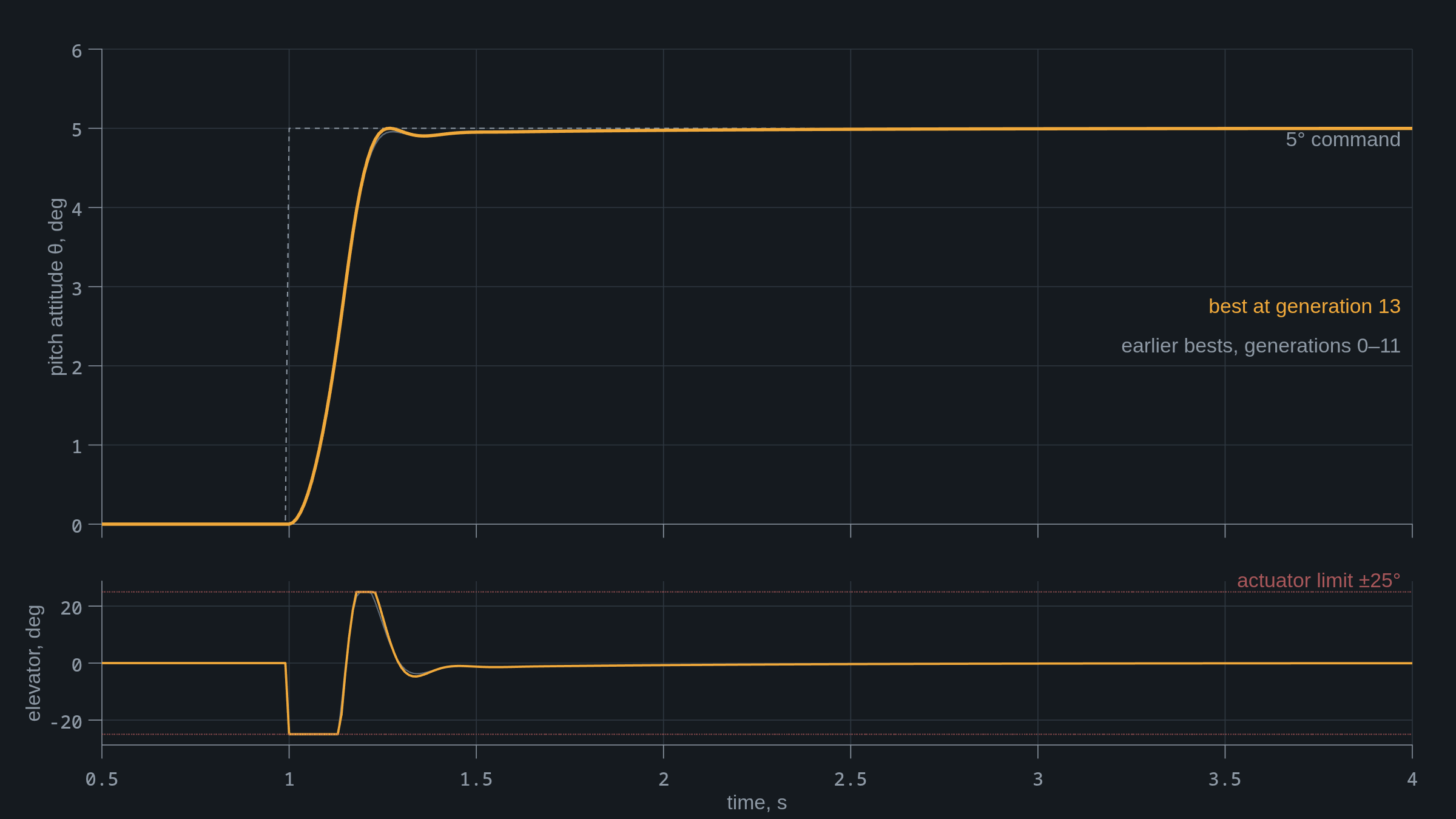
- Every run writes a self-contained folder: configuration, history, the best response at up to eight improving generations, and figures.
- A bounded digest, about 3.4 KB for a 100-generation run, states the outcome first and lists findings with stable rule ids — "reached the target after 656 of 7 208 evaluations", "diversity fell to 2.6 %".
- Runs checkpoint and resume, and a calibrated machine profile prints a wall-clock estimate before any long run starts.
The Studio
The engine also has a window: the MasterGA Studio, a MATLAB app built in code rather than App Designer. Pick a problem and a preset, press Run, and watch the score, where the search is looking, its diversity and the best response redraw every generation; afterwards, replay the run in two or three dimensions and compare presets on the same problem.
Tuning the tuner
The meta-GA is a GA whose candidates are GA settings. Each candidate is scored by running the inner GA over several seeds, so a setting that wins once by luck does not survive. Two targets come out of it for each problem: a balanced preset that is cheap and always on target, and a reliable one whose worst seed is still good.
On the short-period pitch problem, at an equal 5 000-evaluation budget, the reliable preset has a seed spread 26× tighter than the best hand-written preset, thorough, while spending 36 % of its evaluations. The outer level runs on 8 parallel workers, which cut one tuning stage from about 11 minutes to about 2.5.
Traps, and getting out of them
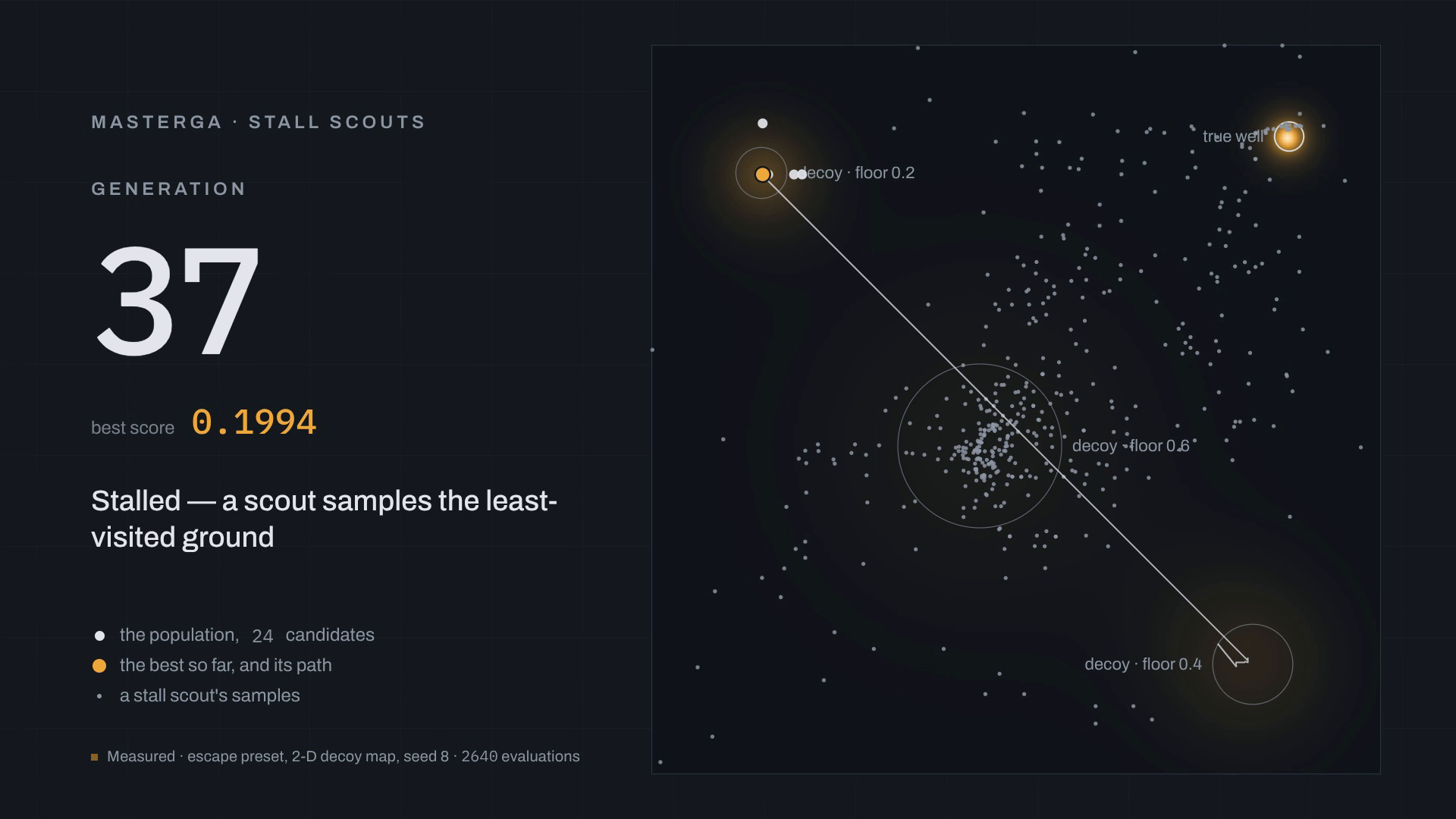
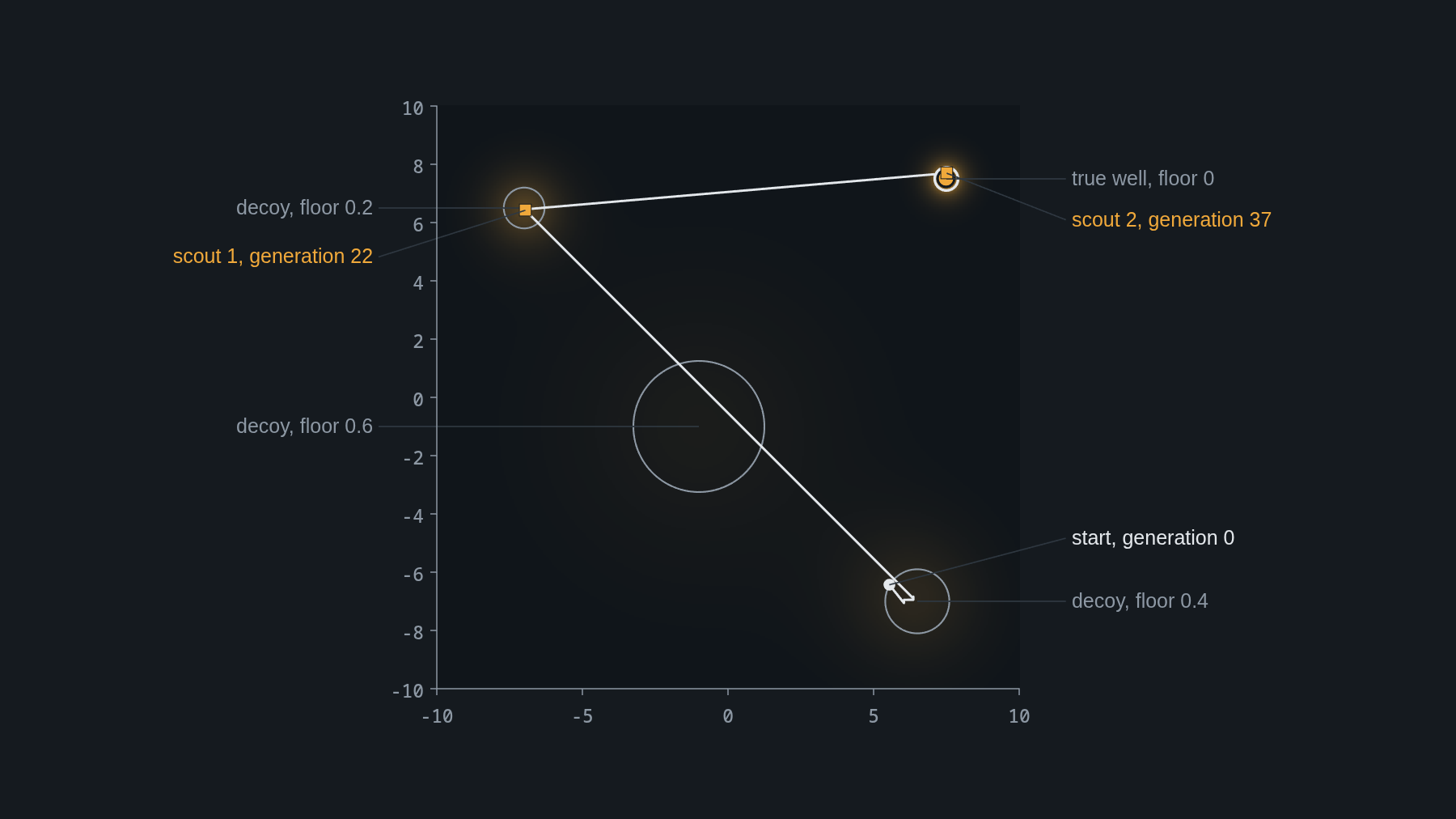
A GA that converges fast converges into the nearest trap. To see that happen, a decoy problem hides one narrow true well among wider, shallower decoys. When a run stalls with budget left, a stall scout searches the least-visited part of the space and, if it finds something better, moves the population there.
On a fixed 2-D decoy map, the escape preset ends in the true well on 28 of 50 seeds, against 10 for standard. It is not a reliable show: a scout that finds nothing better ends the run, which happens on 22 of 50 seeds.
No preset wins both
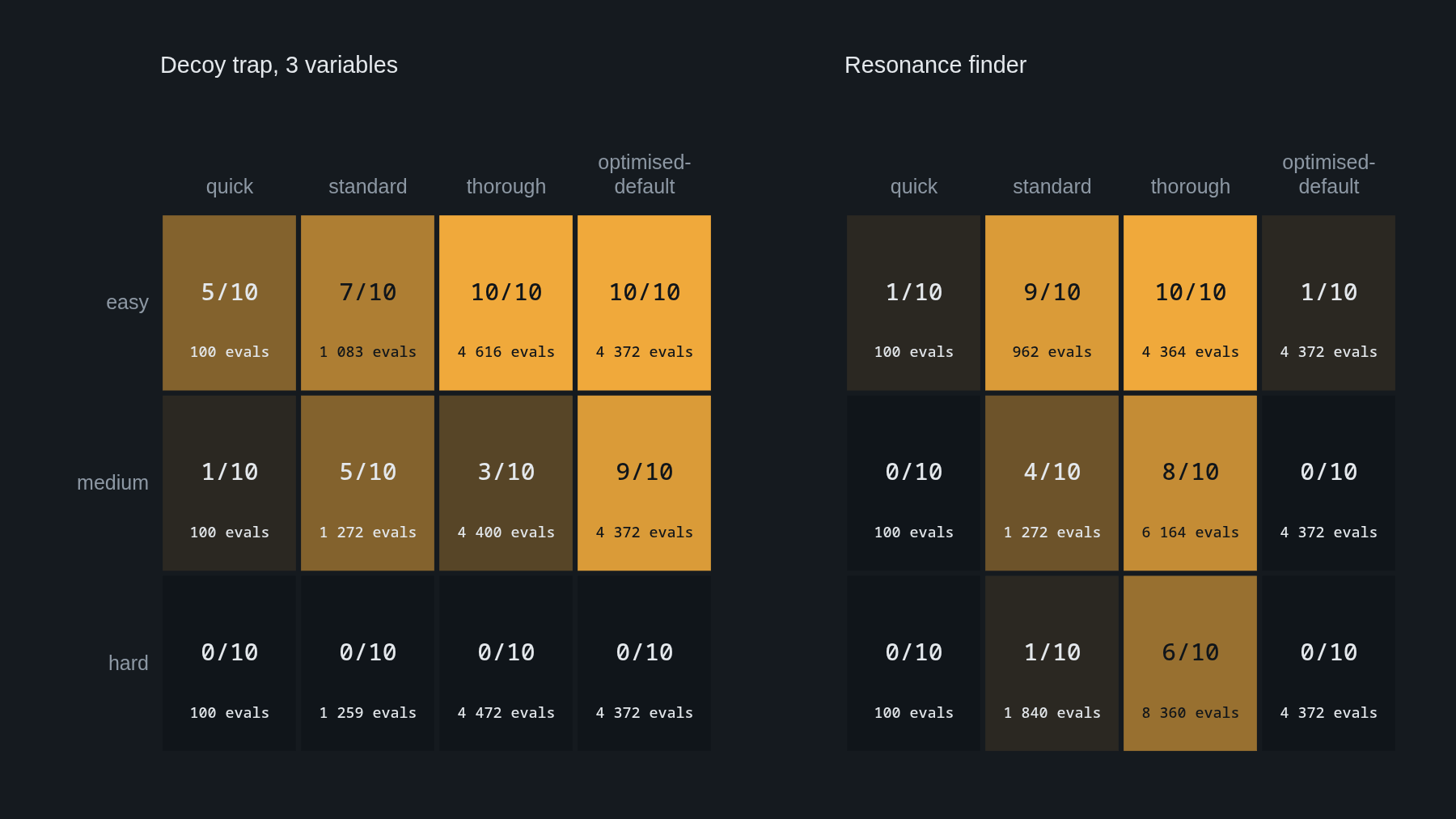
A second proving ground asks the GA to find two to four tones in a noisy signal, where a weak tone beside a strong one is the trap. Run against the decoy problem at three difficulties, ten seeds a cell, the presets split.
The capstone's tuned set escapes the decoys — 9 of 10 at medium difficulty — but cannot separate close tones. thorough is the reverse, finding the hard resonance case 6 times in 10. Nothing yet finds the hard decoy, which makes it the next target for the meta-GA.
Against simpler methods
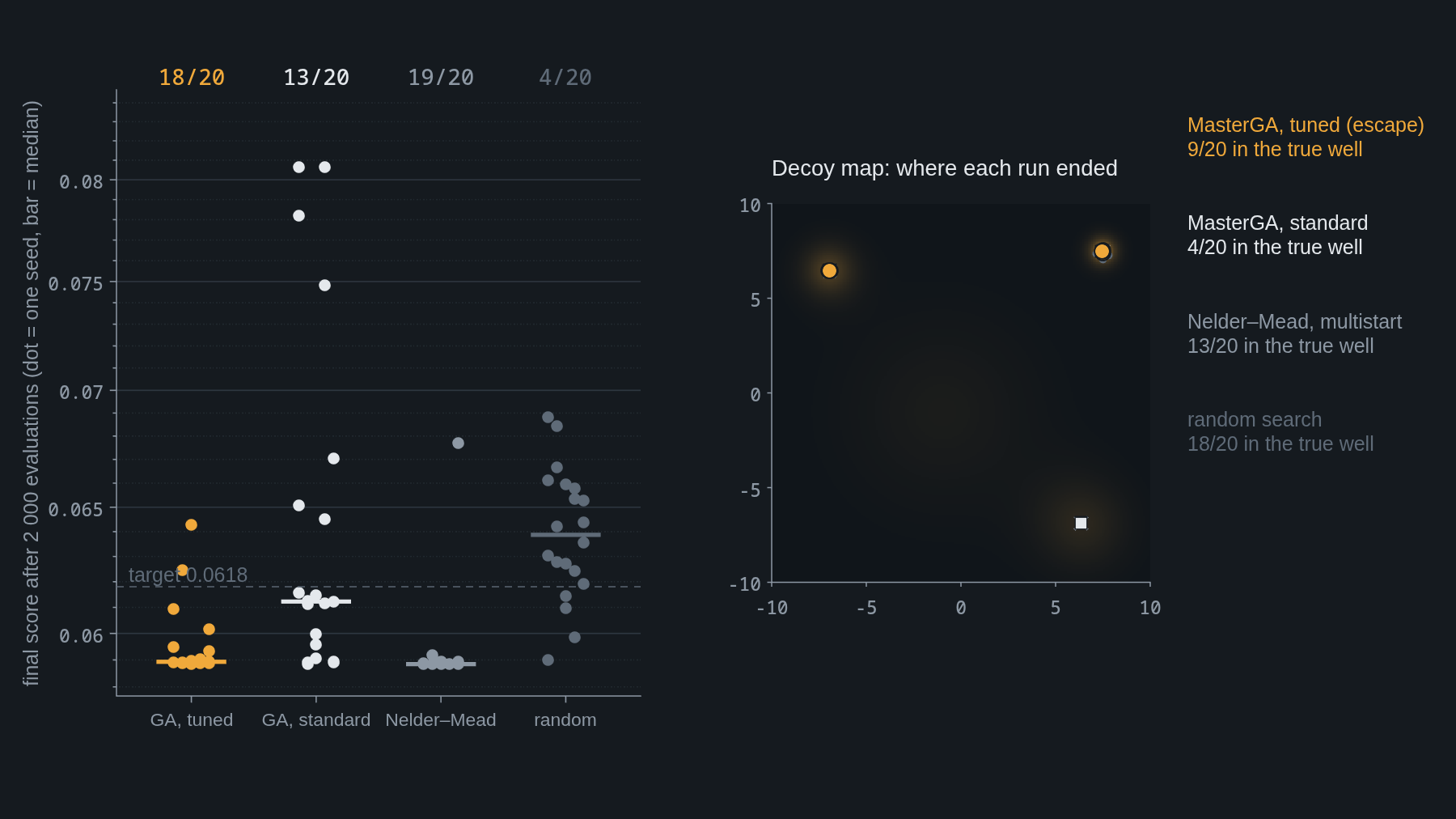
Is a genetic algorithm the right tool at all? Four methods, the same evaluation budget, 20 seeds each: MasterGA's best preset, its standard preset, random search, and Nelder–Mead — MATLAB's fminsearch — restarted from a random point each time it converges, until the budget runs out.
On the case study's own small problems, the honest answer is no. On the three-gain pitch controller, restarted Nelder–Mead reached the target on 19 of 20 seeds against 18 for the tuned GA, and sooner. On the 2-D decoy map, 3 000 random samples cover the square so densely that random search found the true well 18 times in 20; the escape preset managed 9.
Where a GA earns its keep
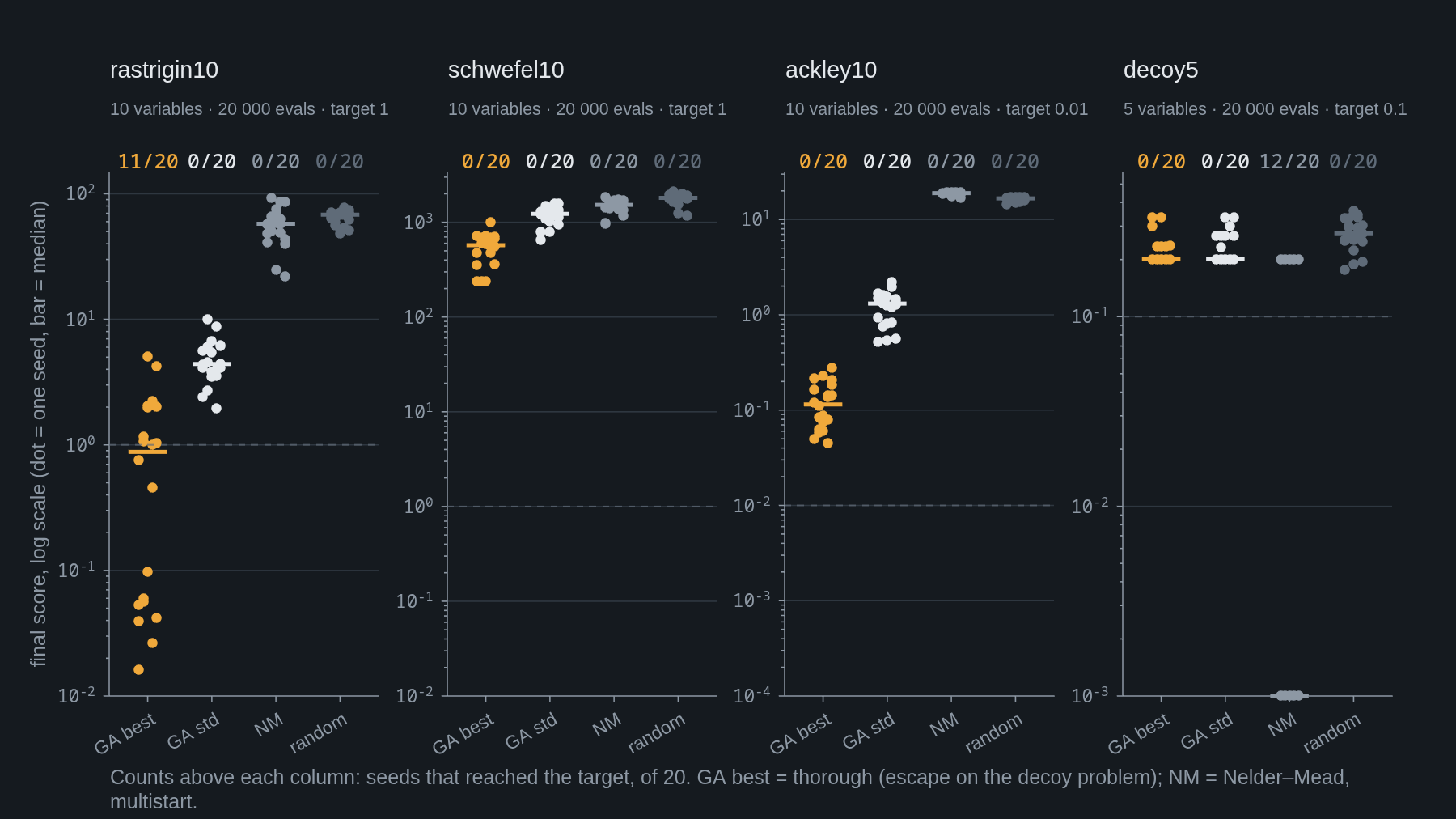
The same four methods on four harder problems, chosen and fixed before any of them was run: Rastrigin, Schwefel and Ackley in 10 variables, and a 5-variable decoy map, 20 000 evaluations each.
On the rugged 10-variable landscapes the GA was the only method to get close. On Rastrigin it reached the target on 11 of 20 seeds; nothing else reached it once. No method reached the Schwefel or Ackley targets, but the GA's median final scores, 574 and 0.115, compare with at best 1530 and 16.7 for the baselines.
The 5-variable decoy map went the other way. Restarted Nelder–Mead found the true well 12 times in 20 and the GA never did: its escape preset ends the run when a scout finds nothing better, after a median of 1753 of its 20 000 evaluations. A continue option for the scout now exists (below), but it has not been re-run on this map.
One problem, four answers
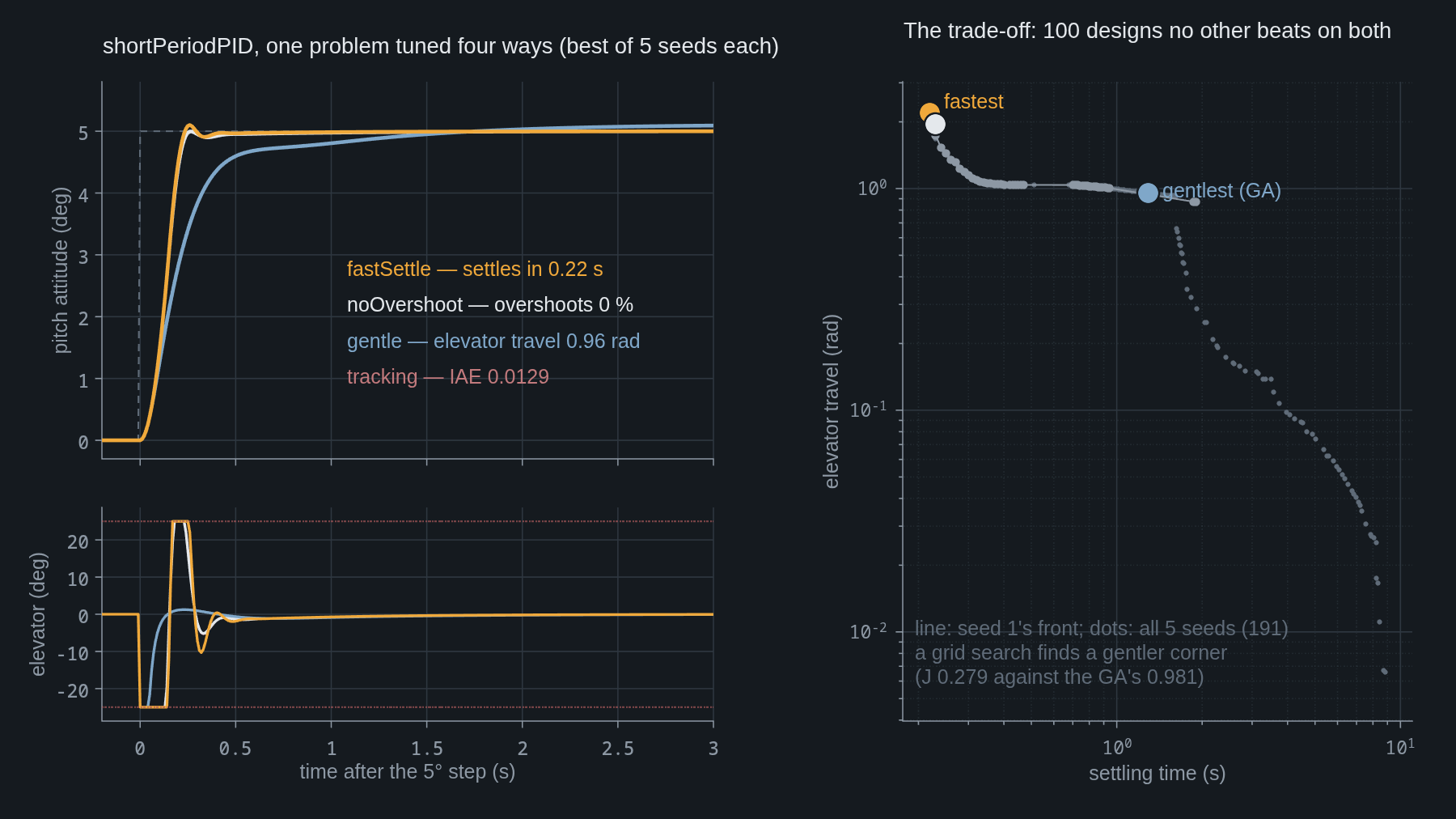
"Best" depends on what you ask for. The same three-gain pitch controller was tuned four times, changing only the fitness: settle fastest, never overshoot, move the elevator least, and the balanced tracking score used everywhere else. Each goal got its own answer: 0.22 s to settle, 0 % overshoot, and 0.96 rad of elevator travel against about 2 for the others. The tracking optimum turned out to be the no-overshoot design again.
Asking for two things at once gives a trade-off rather than a winner. A two-objective run returned 100 designs, none beaten on both settling time and elevator travel. One surprise: a plain grid search found a gentler corner of that trade-off (score 0.279) than any of the five GA runs aimed at it (0.981), a sliver about 1 % wide where the derivative gain is zero.
Damping you can see
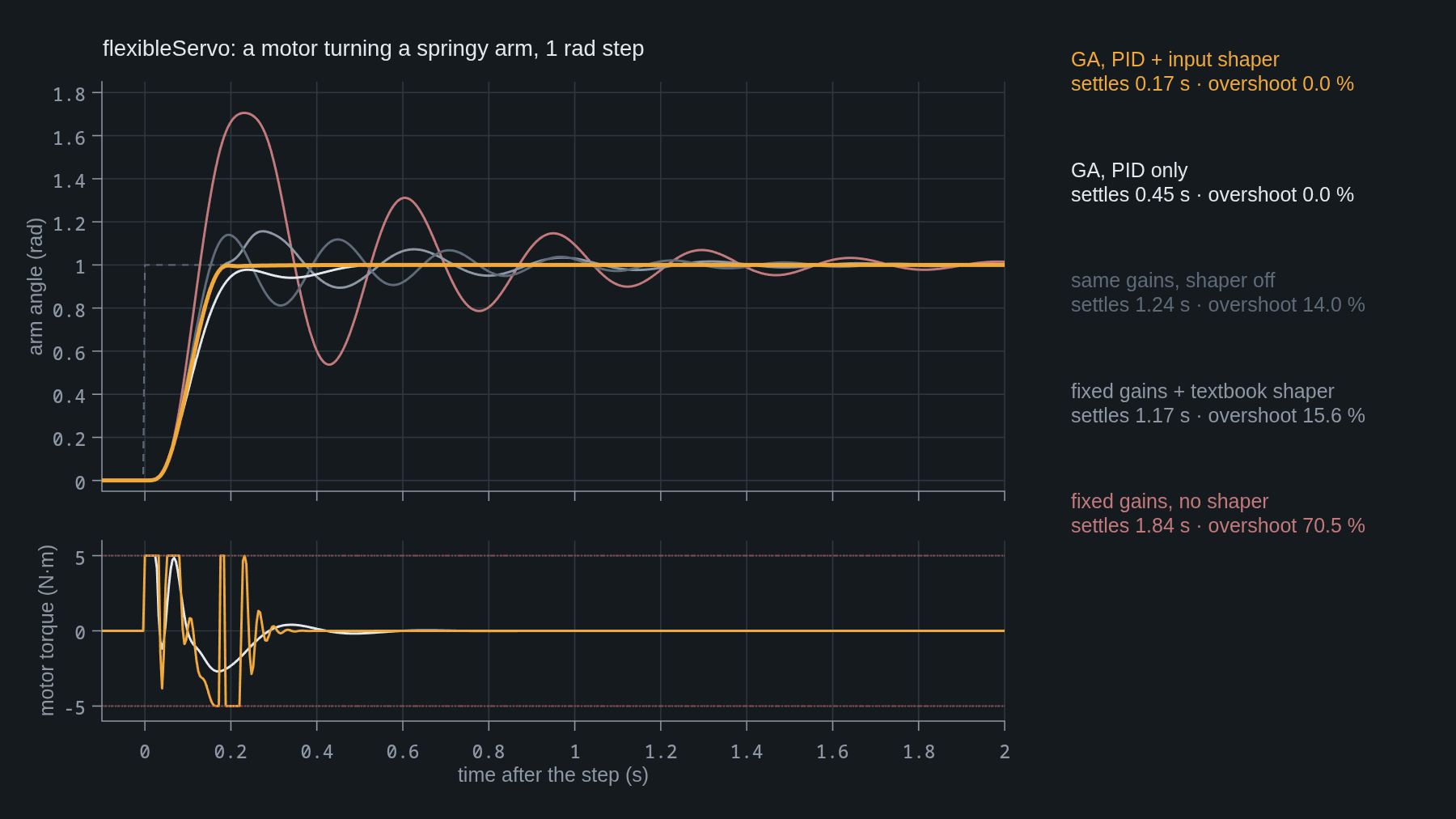
Two new problems where the answer is visible. In the first, a motor turns an arm through a springy shaft, and the arm is what gets scored. With fixed gains it overshoots 70 % and rings for nearly two seconds. The GA's best plain PID settles in 0.45 s. Given an input shaper as well — the command sent in two steps, timed so the second cancels the ringing the first starts — it settles in 0.17 s, 2.6 times sooner. It did not rediscover the textbook shaper: it paired a mild shaper with much stiffer gains, which without the shaper overshoot 14 %.
Comfort against grip
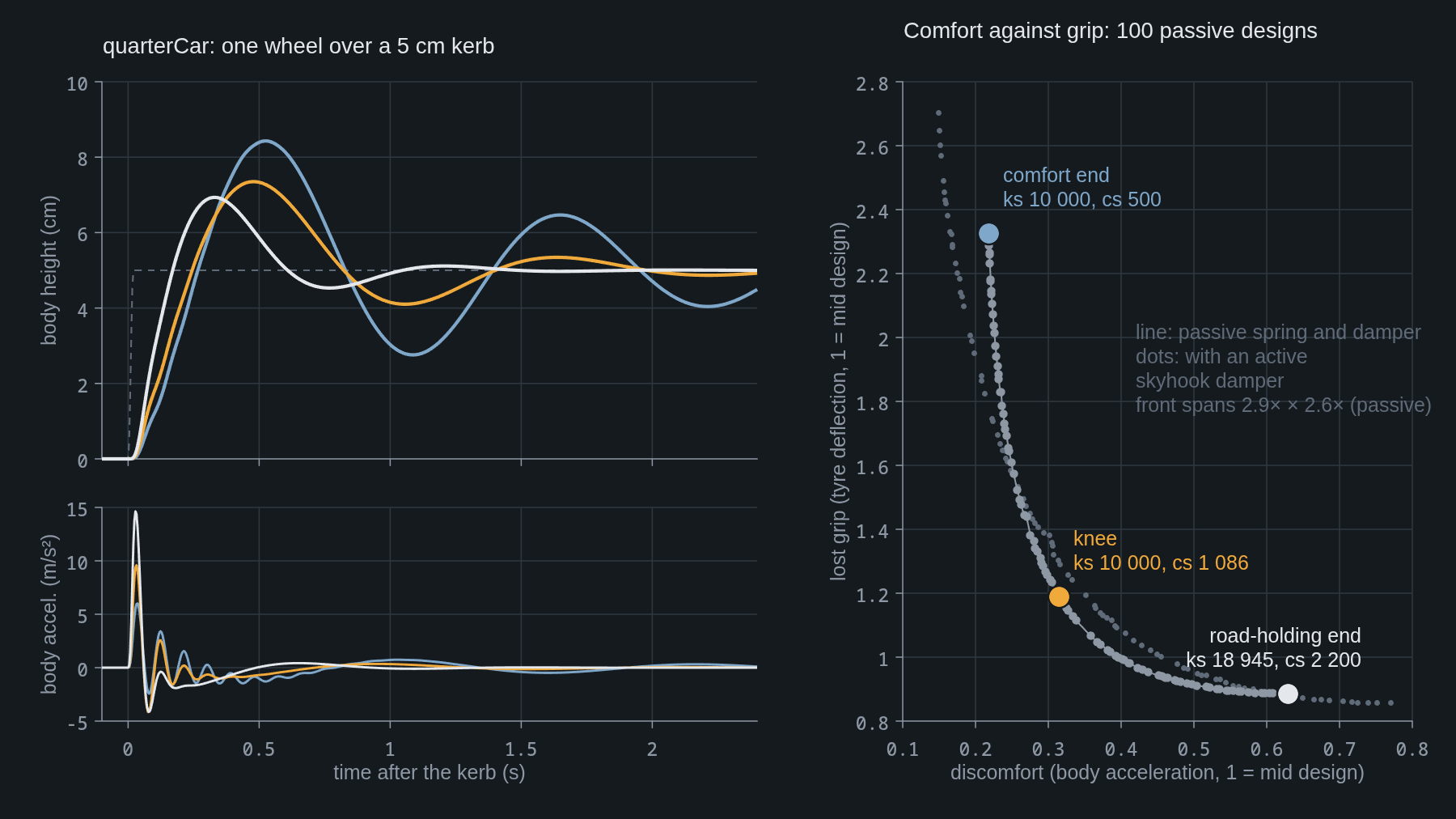
The second is a car suspension: one wheel, a spring and a damper, driven over a 5 cm kerb. A soft suspension is comfortable but lets the tyre lose grip; a firm one keeps the tyre planted and shakes the passengers. There is no single best answer, so the GA returns the whole front: 100 designs, spanning 2.9 times in comfort and 2.6 times in grip. The comfort end sits on the softest spring the design box allows.
One controller for every flight condition
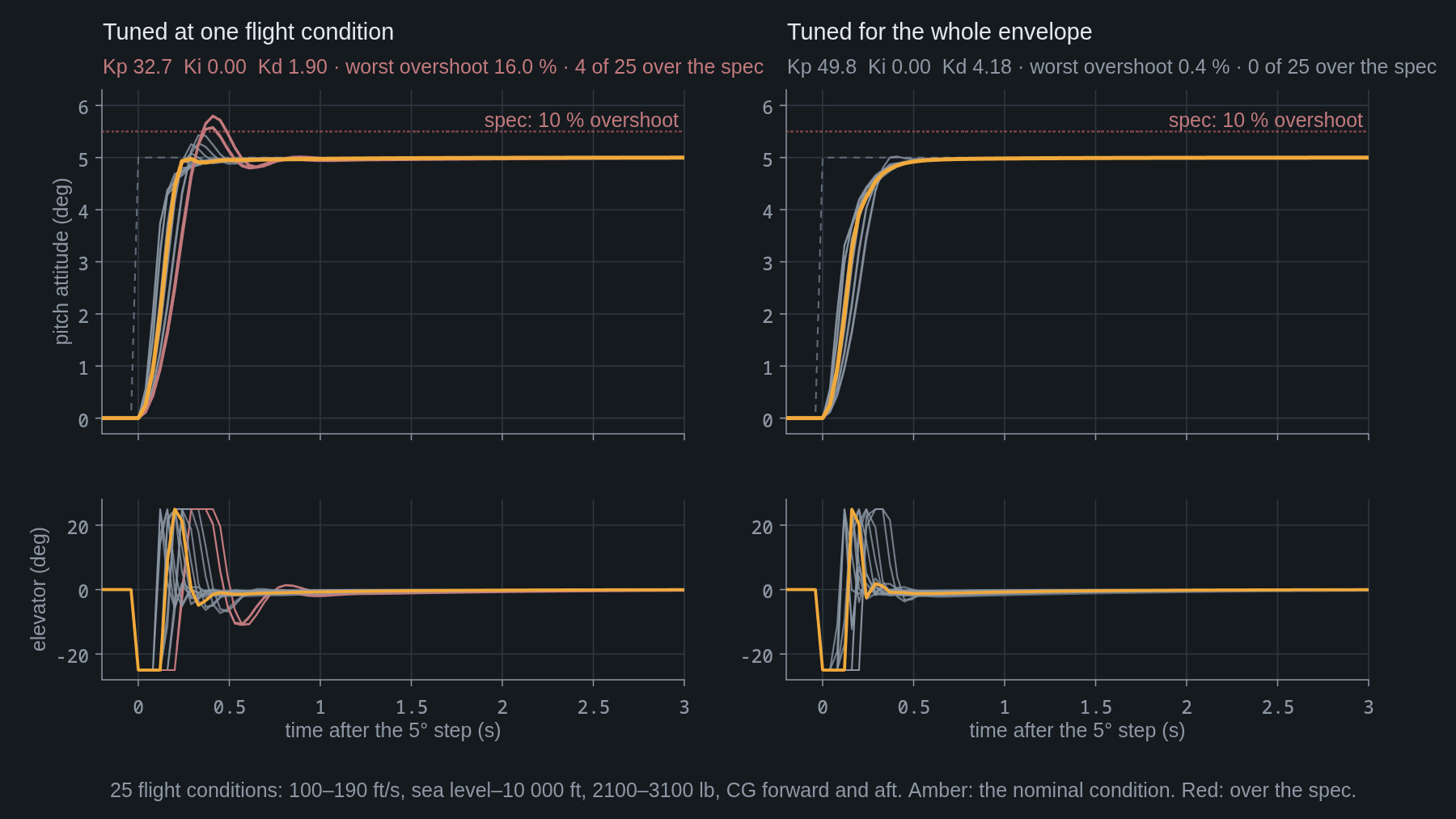
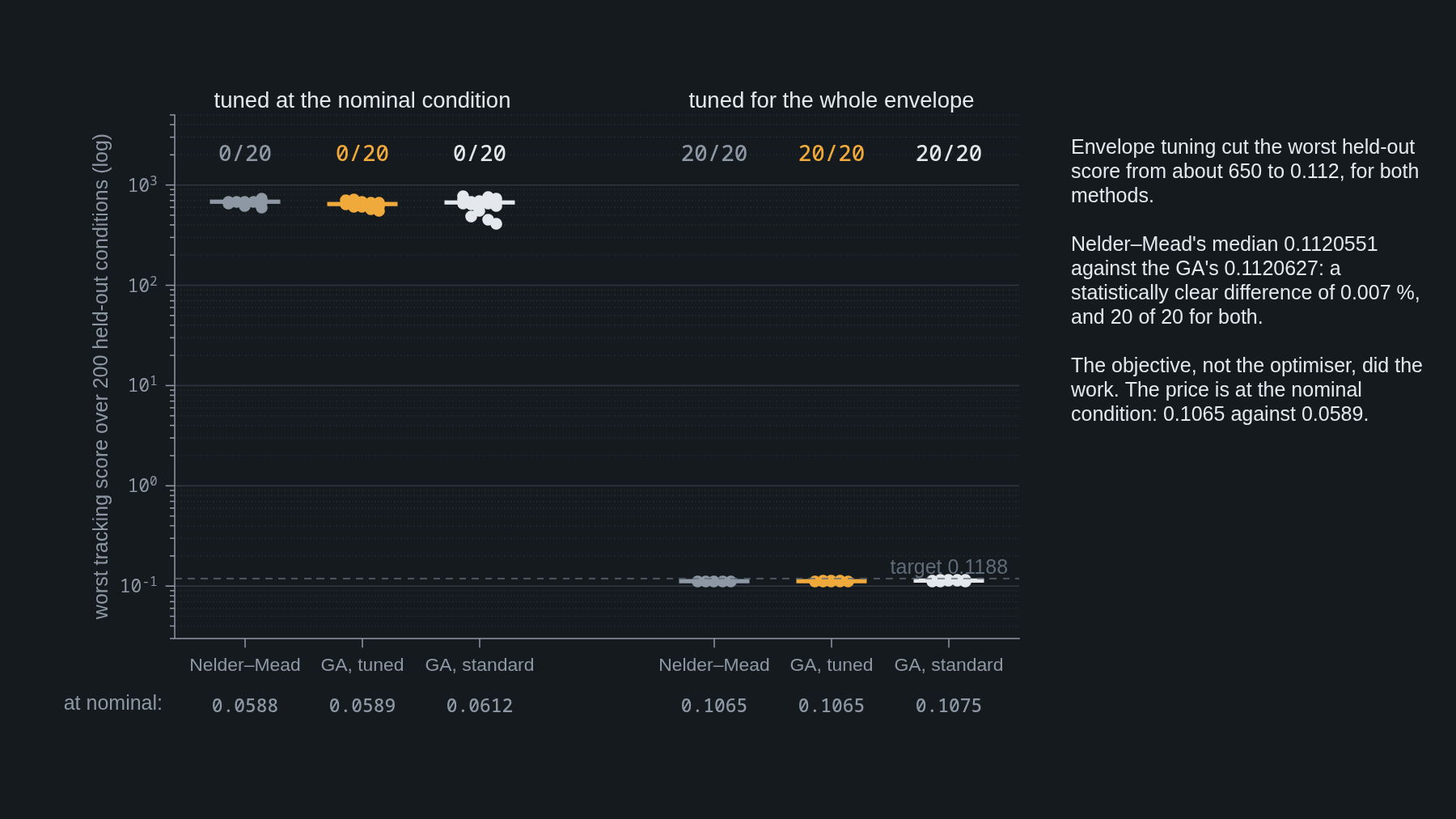
A controller tuned at one flight condition is optimal there and nowhere else. The pitch problem was extended to 25 conditions — 100 to 190 ft/s, sea level to 10 000 ft, light and heavy, centre of gravity fore and aft — and tuned against the worst of them, then judged on 200 conditions it never saw. Tuned at one condition, the best design overshoots up to 16 % and fails the 10 % spec at the slow, high corner. Tuned for the envelope, the worst overshoot is 0.4 % and all 20 seeds meet the target on the held-out set, against none. The price is paid at the nominal condition, where the score rises from 0.0589 to 0.1065.
The objective did the work, not the GA
Is that a win for the genetic algorithm? The experiment was fixed in advance to find out: restarted Nelder–Mead got the same envelope objective and the same budget. It found the same controller. By the pre-registered test it even edged the GA, by 0.007 %, with 20 of 20 seeds on target for both. The gain comes from asking the right question — tune for the whole range — and any competent optimiser can then answer it on three gains. Where the GA should earn its keep is a bigger version: gains scheduled on airspeed, six to nine variables, the size at which it already pulled ahead above.
Can the GA beat the obvious alternative?
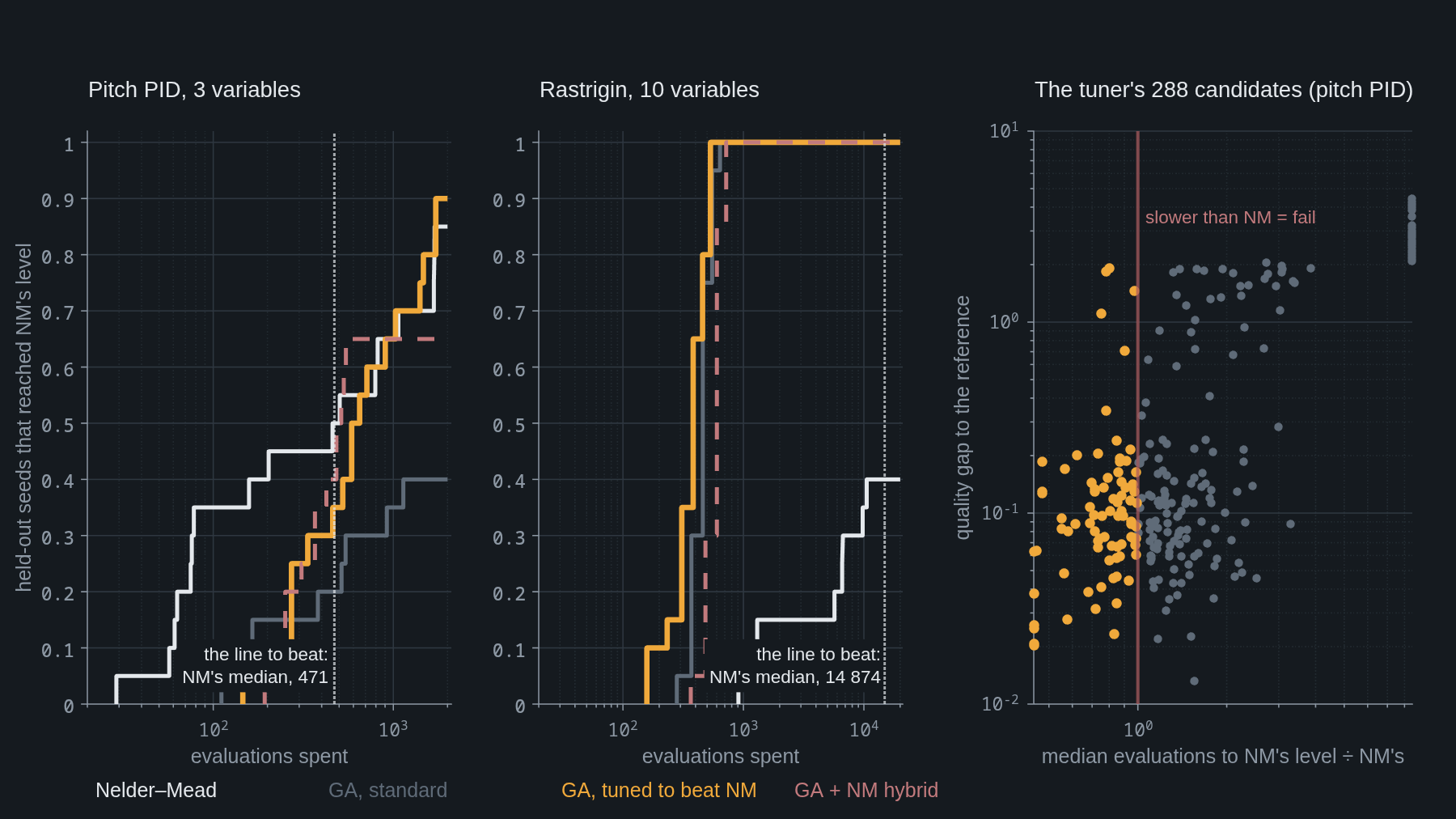
A stricter test, set before any run. Nelder–Mead solves the problem first; the level it reaches and the evaluations it needs become the line to beat, and a GA that needs more is a fail. That rule became the fitness for the meta-GA, which tuned the GA's settings to beat it. Only seeds the tuner never saw are quoted.
On Rastrigin in 10 variables the tuned GA reaches Nelder–Mead's final quality in 2.6 % of the evaluations Nelder–Mead needs, on every held-out seed, and 11 of 20 seeds go on to the real target. On the three-gain pitch controller it cannot: it needs 1.28 times Nelder–Mead's evaluations, with a confidence interval from 0.43 to 8.4. Adding a Nelder–Mead polish to the end of the GA did not beat it either. The GA is faster in wall-clock time on the pitch problem, 0.6 s against 9.4 s, but only because it evaluates candidates in batches, which is not better search.
A side effect: letting the scout keep going when it finds nothing better (a new continue option) took the 2-D decoy escape from 28 to 50 of 50 seeds, at the cost of far more evaluations.
What it has not solved
- Cessna trim to 1e-3. Every seed of every preset ends in the right basin, within 0.5° and 3.3 hp of the exact trim, but no preset reaches a 1e-3 residual at the median. More generations, the stall scout and new operators did not close it; the criterion is 1e-2.
- The hard decoy. Zero of ten for every preset.
- Beating Nelder–Mead on small smooth problems. Even tuned specifically to beat it, the GA needs more evaluations on the three-gain pitch controller.
- Small problems. On two or three variables, restarted Nelder–Mead or plain random search does as well as the GA or better (see above), including over a whole flight envelope. The GA is for rugged, higher-dimensional problems.
- Trim through Simulink. The capstone's Simulink trim problem is flat for a GA, because
trim()solves it from any starting elevator. What to optimise instead is open. - A near-bang-bang controller. Both fitness profiles choose gains that saturate the elevator about 2 % of the time. It was accepted as the design point, and the response figure shows it.